
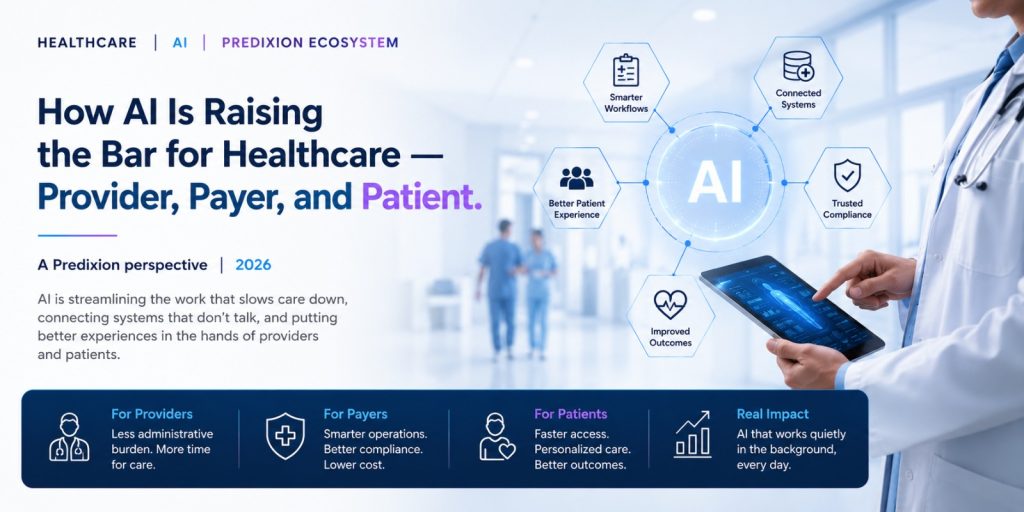
How AI Is Raising the Bar for Healthcare — Provider, Payer, and Patient.
The best healthcare AI doesn’t announce itself. A clinician gets through a shift without three hours of documentation. A patient books an appointment and gets a triage question, not a hold queue. A pharma compliance team clears a regulatory inspection without a single finding. Across the Predixion ecosystem, this is what we’re seeing — AI doing the unglamorous work so the clinical work can actually happen.
Giving clinical time back to clinicians.
In one ecosystem case study, 60 percent of appointment booking was automated end-to-end — symptom intake, urgency classification, slot allocation — without a staff member touching it. Wait times dropped 40 percent. The people who used to field those calls now do work that actually requires them.
In another engagement, low-code process automation covers the full clinical operation. Unified patient portals. AI-guided pre-visit intake. Insurance eligibility checks that run before the patient arrives. Quality measure tracking across HEDIS and PQRS with audit-ready documentation produced as a byproduct, not a project. Revenue cycle and compliance become continuous outputs of systems already running.
Making hospital systems talk to each other.
Most hospitals run more than one EHR system and most don’t connect. In an antibiotic guidance deployment in the ecosystem, the team spent months standardising medical terminologies before a single integration went live. Not exciting work. But once the HL7 FHIR layer was clean, the platform embedded directly into Epic and Cerner — clinical decision hooks, single sign-on, no context-switching for the physician. Hospital onboarding speed tripled. The terminology work is never optional. It’s just rarely credited.
AI directly in the hands of patients.
In one deployment, a HIPAA-compliant mobile app manages a chronic eye condition — symptom tracking, appointment alerts, treatment records — with a live clinical monitoring portal running alongside it for the care team. In another, an Azure OpenAI-powered SMS assistant handles multilingual patient queries round the clock without staff involvement. A third case involves a real-time emergency dispatch platform giving coordinators live visibility across their entire ambulance fleet. Patient-facing AI in the ecosystem is in production. Not on a roadmap.
Mental health: getting the match right.
Most people who need mental health support never reach it — not from lack of willingness, but because finding the right therapist is hard and the gap between wanting help and getting it is where most people stop.
One of the largest mental health platforms in India, built through an ecosystem partnership, runs on a human-AI hybrid model. An AI matching system connects patients to therapists on presenting concerns and therapeutic fit. Over 220 certified psychologists work on it. Thirty million lives have engaged with it. HIPAA-compliant, GDPR-registered, ISO certified. For insurers it powers Employee Assistance Programmes, with HR dashboards surfacing anonymised workforce wellness trends without touching individual records.
Pharma compliance and research intelligence.
A pharma ERP built through the ecosystem covers GMP, FDA, and 21 CFR Part 11 — batch traceability, BMR digitisation, full audit trails. One manufacturer cleared a regulatory inspection using it without a single finding. SAP and Microsoft Dynamics with pharma-specific modules extend that coverage across the ecosystem.
On the research data side, a separate ecosystem engagement clusters clinical trials data automatically, extracts adverse event signals from pharmacovigilance reports with human review in the loop, and maps knowledge graphs across millions of research papers. Runs on-premises. Data stays inside the firewall.
Quality engineering, voice AI, and secured records.
Healthcare software that fails in production delays care. A recent healthtech quality engineering engagement ran HIPAA-compliant testing across patient-facing applications and cut regression time by three times. In a separate case, an AI voice agent now runs at a rehabilitation centre, answering 95 percent of calls within three rings, routing urgent queries to staff 50 percent faster, around the clock. The same team also built a blockchain-secured records platform that reduced data breach risk by 70 percent and cut record access time by 90 percent.
Healthcare improvement is a hundred connected problems. The ecosystem approach puts the right vendor against each one — and the results are already in production.
Predixion curates a vendor ecosystem spanning AI-powered clinical workflows, HIPAA-compliant healthcare automation, EHR interoperability, mental health technology, pharmacovigilance AI, clinical research analytics, and health insurance intelligence. We connect enterprise procurers with the right capabilities through advisory, identification, and governance services.
© 2026 Predixion. All rights reserved.