
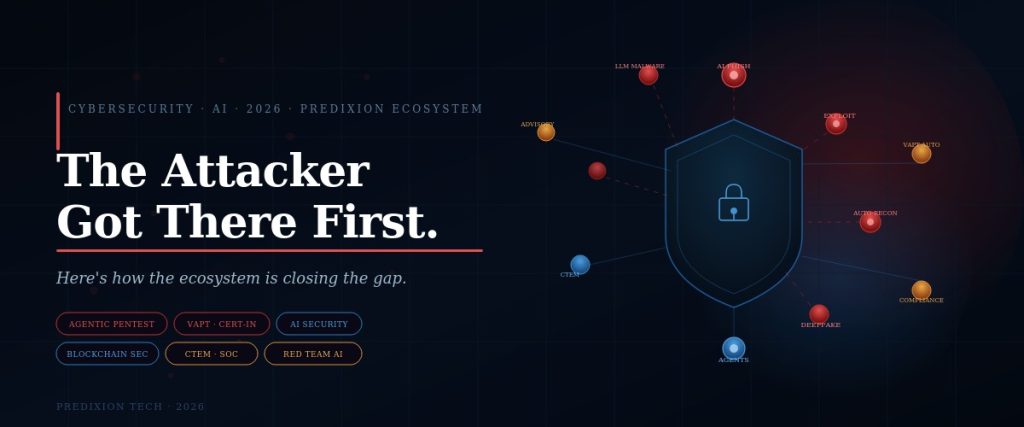
The Attacker Got There First. Here’s How the Ecosystem Is Closing the Gap.
AI didn’t just change how we build software. It changed how we get attacked. The same technology powering enterprise productivity tools is now writing more polished phishing emails, scanning for exploitable vulnerabilities at machine speed, and enabling attack techniques that no human red team could sustain manually. The Predixion ecosystem has been watching this shift — and building for it.
What’s changed on the attack side.
AI-generated phishing is often more polished and harder to spot than anything produced manually — contextually aware, personalised, and structured to mirror how real colleagues write. Automated tools now chain discovered weaknesses into multi-step attack paths in a fraction of the time it would take a human team. Deepfake audio and video are increasingly used in social engineering scenarios. And attackers are experimenting with AI-assisted malware and adaptive techniques that adjust based on the environment they encounter. That older playbook — annual pen test, quarterly patch cycle, perimeter firewall — is increasingly insufficient against threats that move at this pace.
Validating what’s actually exploitable — not just what a scanner flagged.
A standard vulnerability scanner can often return thousands of findings. Security teams spend significant time triaging them, only to discover that many are not exploitable in their actual environment. The real risks get buried in the noise.
One vendor in the ecosystem has built an agentic pentesting platform that approaches this the way an attacker would. AI agents chain real exploits across network, cloud, and Active Directory to validate whether a finding is genuinely dangerous in context — not just theoretically possible. The platform runs continuously, integrates into DevSecOps pipelines so vulnerabilities are caught before code ships, and carries strong third-party review ratings from enterprise security teams, reflecting the practical difference this approach makes to how security teams spend their time.
Continuous VAPT and compliance — at global scale.
Another vendor in the ecosystem — CERT-IN empanelled and operating across multiple geographies including India, the US, UK, UAE, and Singapore — has built an automated VAPT platform with real-time dashboards and reporting designed to help support audit readiness for frameworks including SOC 2, ISO 27001, PCI DSS, GDPR, and HIPAA. Red team assessments, IoT security testing, secure code review, and cloud security assessment all sit under the same roof. For enterprises managing compliance obligations across jurisdictions, the shift from periodic testing to continuous monitoring is the difference between security as a project and security as an operational state.
Blockchain: when the immutable record is also the target.
Smart contracts are typically immutable once deployed. A vulnerability present at launch can persist unless mitigated through upgrade patterns or governance mechanisms — which is why getting security right before deployment matters so much. The ecosystem includes blockchain vendors who build security in from the start: pre-deployment smart contract audits, zero-trust verification, AML screening, KYB identity validation, and fraud detection embedded into the transaction layer. For any enterprise moving financial operations onto distributed ledgers, this is architecture, not an afterthought.
The frontier most security teams haven’t caught up with yet.
NIST and the UK government’s AI security guidance both identify a category of threats that most enterprise security programmes haven’t fully addressed: the AI system itself as an attack surface. Prompt injection, data poisoning, model poisoning, and broader AI lifecycle security risks are recognised attack classes affecting real deployments. Enterprises running agentic workflows or LLM-powered applications need to apply the same rigour to AI security that they apply to application and network security. The AI development vendors in the ecosystem build with security-by-design principles and governance requirements in mind — because their enterprise clients are asking for it, and because failures in agentic systems can propagate in ways that are difficult to contain after the fact.
Posture before tools.
Buying tools isn’t the same as having a security posture. The ecosystem includes consultancy vendors who do the harder upstream work: security roadmaps, risk-based prioritisation, and end-to-end strategy. Many breaches reflect gaps in governance, prioritisation, and threat modelling rather than a shortage of security products. Knowing what you’re protecting and what an attacker would most plausibly target first — that work has to happen before any tool gets purchased.
AI changed the attack. The defence has to change with it — continuously, automatically, and with a clear-eyed view of what’s actually reachable. That’s what the vendors in the Predixion ecosystem are building for.
Predixion curates a vendor ecosystem spanning agentic pentesting, continuous VAPT, AI-powered exposure management, blockchain security, AI system security, and strategic cybersecurity advisory. We connect enterprise procurers with the right capabilities through advisory, identification, and governance services.
© 2026 Predixion. All rights reserved.