
When the Factory Floor Goes Digital — Deep Tech Innovation Across Supply Chain and Manufacturing
Manufacturing and supply chain have always been hard. Long lead times, unpredictable demand, machines that break at the worst moment, shopfloors still running on paper. What’s changing fast is how much of that hardness is now genuinely solvable — with AI, IoT, augmented reality, and digital twin technology that’s well past proof-of-concept. Here’s what we’re seeing across the Predixion ecosystem.
IoT and AI are turning factory machines into their own engineers.
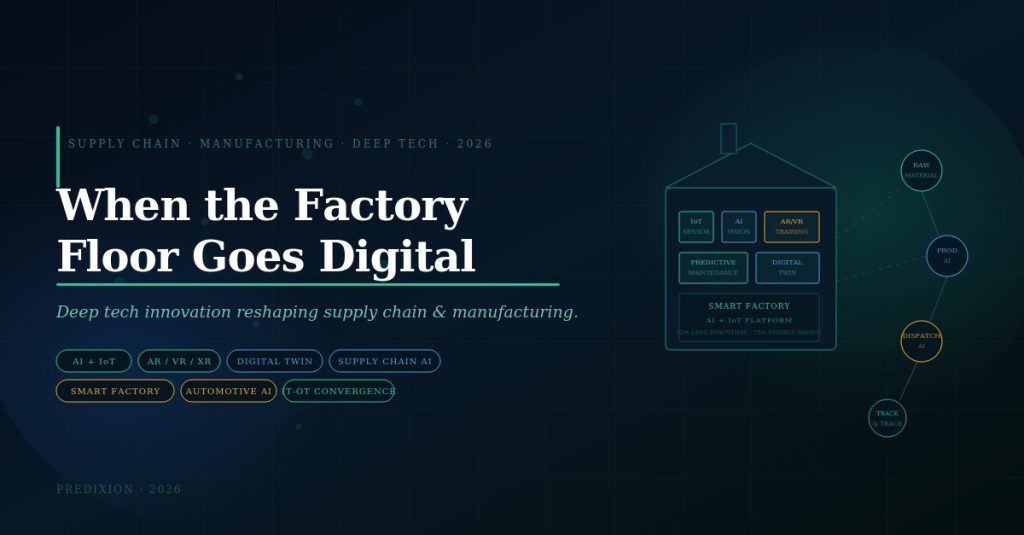
The most tangible innovation we see in manufacturing right now isn’t a new robot. It’s a factory that can diagnose itself. One vendor in the ecosystem has built an IoT platform that sits on top of existing CNC machines and production equipment, pulling real-time data on every vibration, temperature shift, and power draw. Their Smart Factory AI layer spots patterns that precede failures — before the breakdown, not after. A machine shop running their system cut breakdowns by 62 percent. A precision parts manufacturer increased productivity by 52 percent. A CNC facility across India and Germany cut energy consumption by 75 percent. One of the world’s largest motorcycle manufacturers improved supply chain management by 34 percent using their digital twin and paperless shopfloor modules. These aren’t pilots. They’re live results.
AR and VR are solving the training problem nobody had a good answer for.
Industrial training has always been expensive, slow, and risky — put someone on a live machine and hope for the best, or hand them a manual nobody reads. XR is changing that. In the ecosystem, we work with a vendor doing AR and VR deployments across automotive, pharma, oil and gas, and aerospace. In automotive, technicians use AR overlays to guide precision paint application and seal testing on production lines. In pharma, a VR simulator replicates complex tableting machinery procedures so operators train to certification without touching a real machine. In oil and gas, mixed reality guides remote maintenance of control valves in hazardous environments. Onboarding time collapses. Dangerous trial-and-error disappears.
Supply chain AI has moved beyond forecasting. It’s orchestrating.
Demand forecasting was the first AI use case to land in supply chain. It’s table stakes now. One ecosystem vendor has built a full AI supply chain platform spanning raw material procurement through to final dispatch: separate AI modules for demand, replenishment, production scheduling, risk management, order execution, and logistics tracking — all connected, running simultaneously. Their digital twin module simulates supply disruptions before they happen, giving procurement teams time to reroute rather than scramble. They also cover carbon tracking across the supply chain — something that’s moved from sustainability report footnote to board-level requirement. A freight-specialist vendor separately applies AI to truckload and LTL networks, cutting deadhead miles and optimising every load without dispatcher intervention.
Deep engineering: where automotive software meets Industry 4.0.
Some of the most technically demanding work in the ecosystem sits at the intersection of embedded systems, OT networks, and AI. One vendor specialises in automotive software engineering at the chip level — AUTOSAR platforms, autonomous driving and ADAS, vehicle ECU communication protocols, functional safety, and AI/ML in vehicle control units. Another builds IT-OT convergence using OPC UA, the industrial protocol that lets factory machines talk to enterprise software, deploying AI-enabled automation directly into production processes alongside IIoT edge platforms and SCADA integration. This is the plumbing that makes smart manufacturing actually work.
Quality control that runs 24/7, and ERP built for the factory floor.
AI visual inspection identifies production defects at speeds and consistency levels that no human inspector can maintain across a full shift. Combined with predictive maintenance — flagging equipment degradation before it affects output — it creates a quality layer that runs continuously, not just at end-of-line. And underneath all of this, the ecosystem covers manufacturing ERP across SAP, Microsoft Dynamics, and ERPNext — with purpose-built modules for production routing, work-in-progress tracking, quality control, and plant maintenance. Getting the ERP right is still the unglamorous foundation that every other technology layer depends on.
Manufacturing is one of the sectors where deep tech stops being a conference topic and starts being a survival requirement. The ecosystem we’ve built reflects that — vendors who are already inside factories, on production lines, and inside supply chain control towers, delivering results that show up in productivity, efficiency, and bottom-line numbers.
Predixion curates a vendor ecosystem spanning smart factory AI, IoT, AR/VR/XR for industrial training, supply chain AI and transport optimisation, automotive and industrial deep tech, AI visual inspection, predictive maintenance, and manufacturing ERP. We connect enterprise procurers with the right capabilities through advisory, identification, and governance services.
© 2026 Predixion. All rights reserved.